🎬 AI Video Generation Models (2026)
As of early 2026, AI video generation is no longer a futuristic promise or a niche experiment. It has become one of the most contested and fast-evolving frontiers in generative AI.
🚀 The Evolution of AI Video
What started as shaky, surreal clips has rapidly turned into tools capable of producing cinematic shots, coherent motion, and synchronized audio.
The landscape is currently defined by: * Cinematic shots and coherent motion * Synchronized audio integration * Multi-shot narratives from single prompts
🛠️ Cutting Through the Noise
Dozens of models claim “state of the art,” each excelling in different areas like realism, style, speed, and accessibility. This article compares the leading models based on:
- Real user feedback
- Practical limitations
- Day-to-day usability
🔵 Google Veo 3.1
Google DeepMind model powering the Flow AI-filmmaking tool (275M+ videos made). Veo 3.1 (Oct 2025) adds richer audio generation, improved realism/texture, and stronger prompt adherence to the capabilities of Veo 3. It supports text-to-video and image-to-video (with start/end frames, multiple reference images) in up to 4–8 second clips at 720p–1080p, with native lip-synced dialogue and sound effects.
💡 TIP Available via the Gemini app/API and Google Flow, introducing controls like "Frame to Video", multi-reference "Ingredients to Video", and "Extend" mode for longer shots.
✅ Strengths:
- ⭐ State-of-the-art image-to-video fidelity – cinematographic lighting, color grading and detail with natural textures
- Integrated audio (dialogue, effects) with lip-sync
- Character/object consistency with multi-frame references
- Good motion realism in many scenes (realistic gestures and fluid camera movements)
⚠️ Weaknesses:
- Short clip length (~8 sec) and max 1080p
- Temporal stability still imperfect – wider or fast-moving scenes may show flicker or shape warping
- Fine details (e.g. blinking eyelids, small objects) can appear soft or glitchy
- Can still produce an "AI look" in some shots
- Requires Google Flow/Gemini access and usage costs
- No built-in voice cloning (only synthesized speech)
🔧 Improvements Needed:
- Longer, higher-resolution videos beyond 8 sec
- Even smoother frame-to-frame consistency (eliminate flickers)
- Sharper fine-detail rendering (eyes, hands, text)
- More robust multi-character and background motion
- Lower cost / wider API access
- Additional creative styles (cartoon/anime modes)
🟢 OpenAI Sora 2
Second-generation text-to-video model (Sept 2025) for "physically accurate" and controllable generation. Sora 2 builds on the first Sora (Feb 2024) and is claimed to handle extremely difficult physics (e.g. gymnastics, buoyancy) correctly.
⚡ IMPORTANT Generates short videos with integrated audio: realistic background soundscapes, speech, music, and effects. Excels at following multi-shot instructions and preserving continuity across scenes.
✅ Strengths:
- ⭐ – objects behave with real-world physics
- Advanced multi-shot control and consistency – follows complex instructions across multiple camera moves
- High visual quality in both realistic and stylized (e.g. anime) looks
- Built-in audio generation: natural-sounding dialogue, ambient sound, and effects
- Can incorporate real-world references (users can "upload themselves")
⚠️ Weaknesses:
- Still limited video length (8–10 seconds) per clip
- Computationally expensive and currently accessible mainly via the Sora iOS app
- Not perfect – will make mistakes (the model "is far from perfect" and can still glitch)
- No user-supplied voice cloning
- Likely English-centric (multi-language audio support unclear)
- Requires substantial compute resources
🔧 Improvements Needed:
- Support for longer, multi-shot sequences
- Even stronger consistency (eliminate residual physics or continuity errors)
- Broader access (web interface, integration into video workflows)
- Enhanced safety (? mitigation for cloned voices/appearance)
🟡 Kling AI v2.6
Kuaishou/Kling model (Dec 2025) notable for simultaneous audio-video generation. Creates up to 10-second videos that include synchronized speech, narration, sound effects and ambience in one shot.
📝 NOTE Supports both Chinese and English voice synthesis natively, producing layered, mixed audio in lockstep with the generated motion.
✅ Strengths:
- ⭐ One-step video+audio generation – automatically outputs complete video with characters talking, background noise and effects
- Strong audio fidelity and syncing: voices, music and SFX are coherently mixed
- Multi-person dialogue support
- Fast iteration for social ads: intended for marketing/social content
- Supports a variety of audio (speech, rap, singing, SFX, ambience)
⚠️ Weaknesses:
- Still limited to short clips (max ~10s)
- Primarily Chinese-backed (other languages may not be available)
- Likely only available via Kuaishou's platform
- No mention of ultra-high resolutions (probably up to 1080p only)
- Performance on highly complex scenes not widely reported
🔧 Improvements Needed:
- Longer durations (beyond 10s) for extended narratives
- More languages (beyond Chinese/English) and accents
- Higher resolution output (4K support) and finer detail
- Greater creative controls (shot planning beyond auto-schedule)
- Wider accessibility (international APIs or SDKs)
🔮 InVideo AI (Every-Model Platform)
Commercial video creation platform that incorporates multiple back-end generative models (OpenAI Sora, Google Veo, Seedream, Nano Banana) under one interface.
💡 TIP An "AI production house" that can automatically handle scriptwriting, editing and asset selection. Provides text-based editing, voice-over generation in 50+ languages, and easy stock integration.
✅ Strengths:
- ⭐ One-stop solution – supports many cutting-edge models without needing to separately manage APIs
- End-to-end automation – from script to storyboard to editing is built-in
- Easy to use with conversational or bullet-point prompts
- Integrated voiceover and stock libraries save time
- Fast performance through cloud infrastructure
⚠️ Weaknesses:
- Output quality depends on chosen backend model
- Not the absolute cutting edge: results slightly less refined than the native model
- Subscription cost and AI credit limits
- Less control over low-level details
- Watermark on free tier outputs; premium needed for full resolution
🔧 Improvements Needed:
- Add more models and customization (WAN 2.6, Luma Ray3)
- Longer video support and finer iteration (frame-level editing)
- More transparency/control for advanced users
- Lower cost-per-minute
- Continued enhancement of the AI agent
🟠 Wan 2.6 (Alibaba/Wan AI)
Alibaba Group model (released late 2025) focused on consistent multi-shot storytelling in cinematic quality. Supports text-to-video, image-to-video and even short video references (up to 5s) for very tight continuity.
⚡ IMPORTANT Produces longer clips (up to 15 seconds) at 1080p – longer than many competitors. Natively generates audio-dialogue and synchronized sound, supporting multi-character dialogue and music.
✅ Strengths:
- ⭐ Reference-driven generation – can ingest images, audio clips or even short videos to preserve character identity
- Seamless multi-shot videos – understands shot-level instructions
- Native audio co-generation – produces coherent speech and sound effects
- Higher capacity (up to 15s, 1080p) and cinematic rendering
- Significantly improved fidelity compared to Wan 2.5
⚠️ Weaknesses:
- Length capped at ~15 seconds
- No 4K support (1080p max)
- Lacks built-in advanced controls (keyframes, per-shot editing)
- Model and interface are mainly China-based
- Styles oriented to realistic/advertising content
🔧 Improvements Needed:
- Upgrade resolution (support 4K HDR)
- Add more artistic styles (fantasy, sci-fi aesthetics)
- Offer finer manual controls
- 🎨 Runway Gen-4
- Announced 2024 – a breakthrough in consistency and controllability. Allows generating characters and objects that remain identical across multiple scenes from a single reference.
📝 NOTE Supports dynamic camera movements with realistic physics, maintaining lighting and perspective. Introduced workflows for consistent characters, object placement, keyframe control, and basic physics simulation.
✅ Strengths:
- ⭐ Unprecedented subject consistency – the same character or object appears identically no matter camera angle or scene
- Cinematic quality – smooth camera pans, coherent lighting, realistic motion
- Strong world understanding – maintains context and follows complex prompts closely
- Innovative controls (visual keyframing, visual annotations)
- Good handling of multi-shot, multi-camera sequences
⚠️ Weaknesses:
- Output length remains short (seconds) and credit-intensive
- No native audio output (video-only)
- Can glitch on very complex causal sequences
- Requires Runway subscription and online interface
- Fine detail in extremely large scenes can still look synthetic
🔧 Improvements Needed:
- Integrate audio generation for complete clips
- Better addressing of known video-model issues (causal reasoning, object permanence)
- Reduced compute cost per second
- More export features (higher frame-rate, frame-by-frame tweaking)
🚀 Runway Gen-4.5
- Dec 2025 – enhanced successor to Gen-4 and currently leads text-to-video benchmarks. Designed for even greater visual fidelity, motion realism and controllability.
⚡ IMPORTANT Set a new high score (~1247 Elo) on the Artificial Analysis T2V leaderboard, surpassing all known models. Offers "Draft" mode for rapid iteration (5× faster, cheaper).
✅ Strengths:
- ⭐ Best-in-class fidelity and physics: objects and fluids behave realistically
- Top benchmark performance (state-of-the-art realism and prompt adherence)
- HDR pipeline: 4K HDR output with 16-bit color and EXR export
- Wide style support (real, anime, stylized)
⚠️ Weaknesses:
- Still shares fundamental limitations of video AI (occasional cause-effect errors)
- Requires subscription usage
- Most photorealistic settings can be slower/costlier
- No built-in audio
- May occasionally hallucinate or distort in very complex scenes
🔧 Improvements Needed:
- Eliminate residual artifacts (improve temporal consistency further)
- More efficient generation
- Longer realistic clips
- Integrate native audio/video synchronization
🎭 Seedance 1.5 Pro (ByteDance)
- Late 2025 – multimodal video-audio model designed for rich storytelling. Generates both video and sound in one pass and "accurately follows complex instructions".
💡 TIP Supports many languages with good lip-sync. Handles complex cinematography: from subtle close-ups to wide shots, aiming for "film-grade" detail and composition.
✅ Strengths:
- ⭐ Native audio-visual generation – produces dialogues, music and ambient sound fully aligned with the video
- Cinematic visual quality – handles elaborate camera moves and lighting
- Cohesive narrative handling – maintains emotional continuity across scenes
- Multi-language support (wide range of languages and dialects in audio)
⚠️ Weaknesses:
- Details are from ByteDance marketing – independent reviews are scarce
- Likely limited to short clips (8–12s)
- Access via ByteDance's Seed platform only (no public API outside China)
- Output specs not fully disclosed (max resolution likely 1080p)
- Potentially geared toward East-Asian content
🔧 Improvements Needed:
- Public release of evaluation results
- Wider availability outside ByteDance
- Longer clip generation and higher resolutions
- Transparent content guidelines and safety measures
- Continued reduction of artifacts
⚡ Grok Imagine v0.9 (xAI)
- X (formerly Twitter) and xAI (Oct 2025) – image-to-video system that turned on audio/video sync and voice control. Converts a single static image into a ~6-second video (24 fps) with integrated sound.
⚡ IMPORTANT Voice-first interface: users can speak prompts directly, and the model responds with a synchronized audio-visual clip. Freely available to X premium users and iOS/Android.
✅ Strengths:
- ⭐ Fully integrated audio: generates music, speech and even singing that match on-screen motion
- Voice prompt support (say your idea instead of typing)
- Very fast, high-fps generation with smooth camera movement (Aurora engine)
- Free access (within the X/Grok ecosystem)
- Strong realism improvements over initial beta (v0.9 "massive upgrade")
⚠️ Weaknesses:
- Very short output (about 6 seconds)
- Limited to image-to-video (no direct text-to-video yet)
- Occasionally misunderstands prompts or produces minor visual glitches
- ????????/abuse risk: no current warnings against using public figures' images/voices
- Model is within the X ecosystem (cannot export raw models)
🔧 Improvements Needed:
- Support longer durations (beyond 6–10 seconds)
- Better prompt handling and more interactive editing
- Content safety (? detection, watermarking)
- Higher resolutions and multi-shot generation
🖼️ Midjourney Video
- Early 2025 – introduced a video feature that animates a single image into a 5-second clip. Users start with any Midjourney image (or upload), optionally add a text prompt, and MJ will produce a brief moving sequence.
📝 NOTE Offers "low" and "high motion" modes (and looping) but remains limited: only 5 seconds long, with motion constrained (pans/zooms or simple object shifts). Output resolution is up to HD (Pro tier).
✅ Strengths:
- Easy to use within the existing Midjourney Discord workflow
- Allows quick "video memes" or simple animations of still images
- Can loop seamlessly (start/end frames the same)
- Leverages Midjourney's strong image style coherence
⚠️ Weaknesses:
- No audio output
- Very limited content – more a novelty than a full T2V system
- Quality of animation is mediocre compared to dedicated video models
- Lacks multi-shot narrative or complex scenes
🔧 Improvements Needed:
- Add audio capability
- Enhance realism and scene transitions
- Ultimately, Midjourney's focus remains image-generation
✨ Luma Ray 3 (Luma AI Dream Machine)
- 2025 – aims for production-grade results with advanced user controls. Co-developed with film and gaming studios, supports "Character Reference" (locking a subject's identity across shots) and true HDR output.
⚡ IMPORTANT Features reasoning-guided generation (the model "thinks in concepts", self-evaluating drafts). Uniquely produces 16-bit 4K HDR footage with EXR export for professional pipelines.
✅ Strengths:
- ⭐ – realistic lighting, reflections, and motion blur
- Advanced controls: keyframe editing, start/end frame modifications, visual annotations
- Consistency: accurate character identity and object placement across scenes
- HDR support – first model to output true 4K HDR video and 16-bit frames
- Reasoning engine – the AI refines its own outputs to improve each result
⚠️ Weaknesses:
- Requires high compute (likely cloud-based on Luma's servers)
- Accessibility limited (only via Dream Machine app or enterprise)
- No built-in audio
- May still exhibit rare inconsistencies on very complex tasks
- Proprietary – not open-source and tied to Luma's paid service
🔧 Improvements Needed:
- Add audio/speech capability to match its visual ambition
- Lower resource cost (better efficiency) for broader use
- More user-facing simplicity
- Ongoing tuning of consistency
💃 Hailuo 2.3 (MiniMax)
- Oct 2025 – MiniMax (China) model focusing on dynamic movement and style stability. Optimized for high-action scenes (e.g. dance routines) and anime/special-art styles.
💡 TIP Greatly improves on complex choreography: generates fluid, detailed dance and sports motion with accurate limb movement and natural camera tracking. A "Fast" variant offers very quick rendering at same pricing.
✅ Strengths:
- ⭐ Superior motion realism – understands weight, momentum and camera movement
- Outstanding support for anime/cartoon styles – visuals remain consistent frame-to-frame
- Rich facial expression and emotion (micro-expressions look natural)
- Integrated audio (native dialogue and sound) akin to Veo/Sora
- Cost-effective (fast mode is cheaper)
⚠️ Weaknesses:
- Primarily tuned for human/anime subjects – may underperform on random or static scenes
- Output length likely limited (~8–12s)
- Interface/API mostly in Chinese (international UX may lag)
- As a newer model, long-range context handling is unproven
- No official independent benchmarks in English media yet
🔧 Improvements Needed:
- Better international availability (multi-lingual UI, docs)
- Continued reduction of minor artifacts
- More transparent integration (global API access outside China)
🏁 Conclusion
- As of early 2026, AI video generation has crossed a clear threshold: this is no longer experimental tech, it’s a fast-maturing creative medium. The gap between “impressive demo” and “usable daily tool” is closing quickly.
- Models like Veo, Sora, Runway, and Luma are pushing realism, physics, and consistency to levels that would have been unthinkable two years ago, while platforms like InVideo and Grok are aggressively lowering the barrier for everyday creators.
⚠️ Challenges & Friction Points
That said, no model is complete.
- The following remain the biggest friction points: * Short clip limits * High costs * Inconsistent temporal coherence * Weak audio integration
- The winners going into 2026 won’t just be the models with the best visuals, but the ones that combine longer duration, reliable consistency, native audio, strong control, and broad accessibility without turning usage into a budgeting exercise.
🚀 The Future Direction
- The direction is obvious: fewer “wow” moments, more trust.
- When creators stop asking “will this break?” and start asking “what story do I want to tell?”, AI video generation will have fully arrived. Until then, the landscape remains **competitive, fragmented, and brutally fast-moving**—and that’s exactly what’s driving the progress.
BONUS INFOGRAPHIC
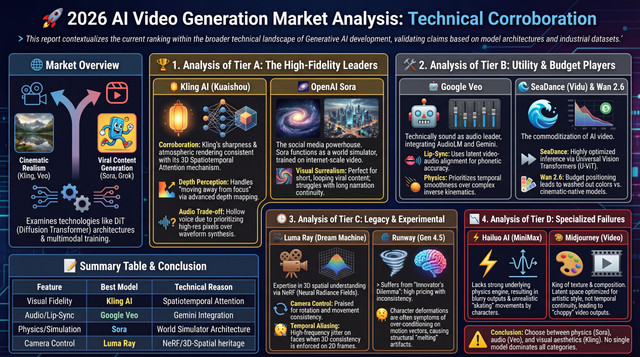
- All information is current as of January 2026.